
Summary
- Wellness is now a business imperative and rising healthcare costs mean employers must make the most of their company wellness program and offer a blend of mental, physical, social, and financial support.
- Participation is a poor indicator of wellness program success. Organizations should focus on wellness program outcomes that align with business goals and employee health improvements.
- Outcome-based metrics integrate data from biometrics, overall health, and behavioral sources and must maintain privacy.
- Technology is essential and success relies on integration, predictive analytics, and a centralized platform.
- CoreHealth helps organizations move beyond activity tracking by measuring meaningful wellness outcomes and population health trends.
Wellness has shifted from a “nice-to-have” perk to a foundational business imperative. As healthcare costs continue to rise, organizations need a company wellness program that delivers measurable value, not just participation. Employee health has become a strategic asset, making it essential to provide a holistic blend of mental, physical, social, and financial support.
However, participation alone does not tell the full story. To understand whether a wellness initiative is creating real value, employers must focus on wellness program outcomes. This article explores how organizations can move beyond activity tracking to measure meaningful outcomes that improve employee wellbeing and support business objectives.
Understanding Wellness Program Outcomes vs Activity Metrics
Wellness program outcomes focus on measurable improvements such as reductions in blood pressure, improved sleep quality, lower burnout scores, and decreased absenteeism. These indicators provide a clearer picture of whether a wellness initiative is improving employee health and supporting organizational goals.
Activity Metrics
These include participation rates, app downloads, gym check-ins, and step-count challenges. While these numbers look excellent on a slide deck, they are leading indicators at best. A high number of app downloads does not guarantee stress reduction, just as a gym check-in doesn’t necessarily equate to improved cardiovascular health.
Outcome Metrics
These metrics focus on results such as reductions in blood pressure, improved sleep quality, lowered burnout scores, and decreased absenteeism. They provide a window into the actual vitality of the workforce. To learn more about structuring these activities, visit the CoreHealth Wellness Challenges page to discover how to design them for real change.
The Engagement Trap
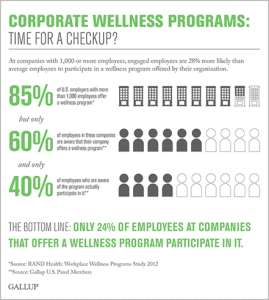
High participation doesn’t always lead to a healthier bottom line or a happier culture. This engagement trap occurs when employees participate for incentives but don’t adopt lifestyle changes. Recent research shows that 80% of large employers provide wellness programs, but only 24% of employees actively participate in them.
Key Wellness Program Outcomes to Measure
To measure what truly matters, organizations must look at primary wellness outcomes. These are tangible shifts in an employee’s health status or behavior that persist over time. Moving to this model requires a more sophisticated tech stack that can aggregate biometric data, self-reported sentiment, and clinical trends while maintaining strict privacy standards.
- Biometric Markers: Monitoring longitudinal changes in BMI, cholesterol, and resting heart rate across a population allows HR leaders to see the physical impact of their programs. Instead of seeing how many people used a scale, you’ll see the average drop in hypertension risk.
- Psychological Safety & Stress: Use validated tools (like the PHQ-9 or GAD-7) to measure improvements in mental health rather than just “meditation minutes.” This data helps identify if the corporate culture is supportive or if wellness is merely a band-aid on a toxic environment.
- Behavioral Change: This involves tracking the sustained adoption of healthy habits, such as tobacco cessation or consistent ergonomic improvements. You can learn more about facilitating these shifts on the CoreHealth Health Coaching blog, which discusses the bridge between data and habit formation.
- Social & Financial Health: Wellness is not just physical. Measuring financial stress and social connectivity within teams provides a more holistic view of the whole employee. High social connectivity is often a precursor to high retention.
Connecting Wellness Outcomes to Business and Workforce Goals
Wellness is no longer a siloed HR initiative; it is a driver of organizational performance. By clustering employee wellness programs around specific business objectives, leaders can prove that a healthy workforce is a more profitable and stable one.
Reducing Healthcare Spend
Positive clinical outcomes directly lower insurance premiums and self-insured costs. When a population’s collective glucose levels or blood pressure readings improve, the actuarial risk decreases. A comprehensive study found that for every dollar invested in wellness programs focusing on chronic disease management (an outcome-based approach), companies saw a $3.80 return in reduced healthcare costs.
Retention and “Stay-ability”
There is a direct correlation between high wellness outcome scores and lower employee turnover. Employees who perceive support for their physical and mental well-being are significantly more likely to remain with an employer during periods of market volatility.
Productivity and Presenteeism
“Presenteeism,” the phenomenon of being at work but not fully functioning due to illness or stress, costs companies billions. The new frontier of business analytics is quantifying the “Focus ROI” gained when employees are physically and mentally optimized.
The Role of Technology in Scaling Outcome-Based Programs
Transitioning to an outcome-focused model is impossible without a centralized platform that can handle complex data. In 2026, the “Wellness Ecosystem” is the primary tool for HR leaders, allowing them to see real-time trends and pivot strategies before health issues become organizational crises.
Centralized Data Aggregation
The modern platform must bring together wearable data, health risk assessments (HRAs), and claims data. This creates a single source of truth. You can explore the importance of this integration on the CoreHealth Health Risk Assessment product page.
Predictive Analytics
AI’s ability to identify “at-risk” employee clusters before burnout leads to resignation is a revolutionary breakthrough. By analyzing patterns in PTO usage, engagement scores, and biometric shifts, employers can offer proactive support.
Seamless Integration
Ensuring wellness tools integrate with other HRIS and benefits platforms, like Workday or SAP, creates a unified experience. This reduces “app fatigue” for the employee and ensures the data flows seamlessly for the employer.
The CoreHealth Advantage
The journey from tracking steps to transforming lives requires more than just a philosophy. It requires the right infrastructure. By focusing on measurable wellness program outcomes, organizations move from guessing to knowing. This shift not only protects the company’s most valuable asset, its people, but also builds a culture of genuine care and high performance.
The CoreHealth platform is uniquely positioned to facilitate this evolution. It provides the robust data architecture needed to move beyond simple activity tracking, offering profound insights into population health trends and actionable outcomes. With CoreHealth, employers can personalize interventions at scale, ensuring that every wellness initiative is backed by data and designed to deliver a measurable impact on both employee vitality and the corporate bottom line.
If you found this article helpful, please share it on your social media channels.
